This year RS Aqua was sponsored by the Royal Navy to participate at Robotic Experimentation and Prototyping with Maritime Unmanned Systems (REPMUS) 2026 to test Marlin and its expanding capabilities in a live operational environment. The aim is for potential ASW threats to be detected, classified and tracked in real time.
Bringing together more than 300 unmanned surface vessels and expertise from NATO nations around the world, REPMUS provides an opportunity to demonstrate, test and learn alongside some of the latest developments in maritime technology.
Putting the technology through its paces
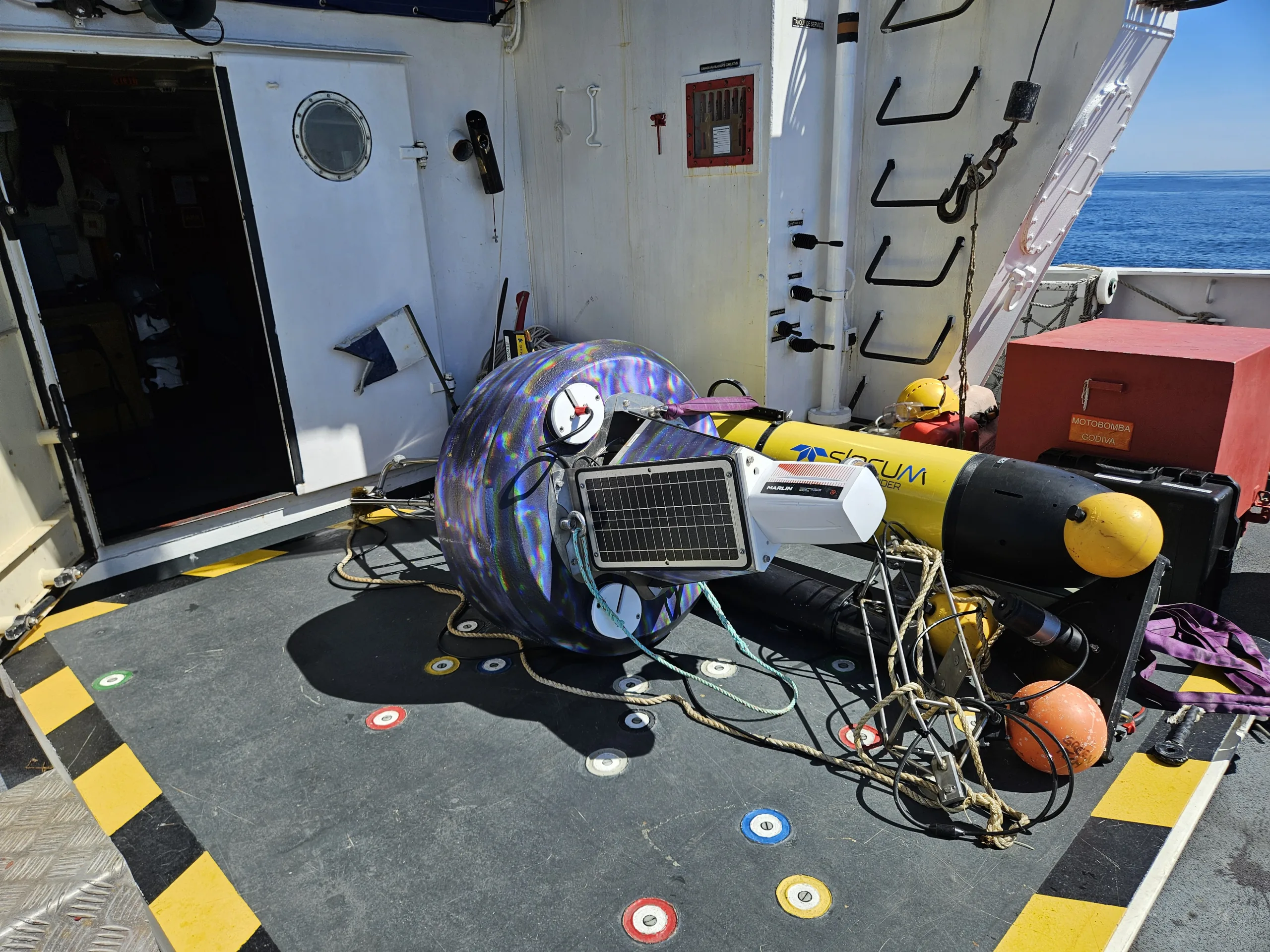
Mounted on a buoy off the coast of Sesimbra, Marlin was deployed alongside supporting technologies to detect and classify targets. The key to the mission was to test Marlin’s machine learning-based acoustic classifiers in a ASW environment.
Sound was detected via a Porpoise single-channel recorder using a GTI hydrophone, at 10m below the surface, with environmental data also fed into the system to support the detection process.
Integrating technologies
A key part of the trial was demonstrating how Marlin could bring together data from multiple sensing technologies.
Marlin was also integrated with MetOcean’s subsurface ASW Profiling Float (NiKA) that silently listens to the ocean at depth with the aim of detecting underwater assets. It then rises to the surface and relays any audio of interest back to the user over the Iridium Certus network.
The NiKA data was processed automatically using the Marlin Connect software, bringing it alongside the buoy data to provide a more complete picture of the mission.
We also trialled an integration with Online Oceans’ USV Scout system, receiving data in real time through Marlin Cloud for analysis. Scouts are persistent autonomous surface vessels which analysis and relay acoustic data in real time from hydrophones hanging below them at 10 – 20 m depth.
The results
Marlin was successfully deployed throughout the trial, with the data collected successfully reported back to NATO with zero reported failures.
Continuous, near real-time data provided throughout the exercise showed promising results for both range and target detection. Marlin achieved its personal best target for near real-time detection at 180 seconds, down from 330 seconds previously.
Additionally, we trialled Marlin’s ability to securely integrate data from multiple nodes in the field, including sensors and hardware from third-party providers. Using the Marlin data API or secure FTP over VPN, data from these different sources can be transmitted directly into the Marlin cloud, where it can be combined, analysed and processed.
By bringing multiple data feeds together, Marlin can go beyond detecting a target to help determine its location, providing operators with a single, common operational picture of activity across the area.
Why do we participate in trials like this?
Marlin has been through extensive testing, but as its capabilities continue to grow, so do the opportunities to put them to work.
Trials like REPMUS give us the chance to test new capabilities in realistic operational scenarios, working alongside other technologies and exploring how Marlin can perform as part of a wider system supporting other technologies with our Marlin Connect software.
It’s an important part of how we develop, putting new features through their paces.
What’s next for Marlin?
Marlin now plans to add more environment sensors to its real time capability list and integrate with other autonomous platforms that do underwater acoustic monitoring. This will allow Marlin to provide a much broader and more accurate operating picture of the underwater environment and localise acoustic signatures in real time.