As offshore wind development accelerates across the UK and Europe, developers face increasing pressure to balance project delivery with environmental and regulatory requirements.
To support this challenge, RS Aqua has introduced a major enhancement to its Marlin underwater acoustic monitoring system, bringing together three critical compliance capabilities.
Designed specifically for offshore wind developers, subsea construction contractors, and marine environmental teams, the latest Marlin update combines:
- Harbour Porpoise Detection
- Acoustic Anomaly Detection
- Impulsive Noise Metrics Monitoring
Together, these capabilities provide a comprehensive solution for environmental monitoring and compliance throughout offshore construction activities.
How do offshore wind farms monitor harbour porpoises during construction?
Harbour porpoises are a protected species and remain one of the most sensitive and closely monitored marine species within offshore development zones. During activities such as seabed piling and construction, underwater noise can disrupt migration routes, feeding behaviours and breeding patterns.
Marlin’s enhanced harbour porpoise detection capability continuously monitors for the high-frequency clicks produced by these marine mammals, providing operators with near real-time awareness of their presence within the project area.
This data helps developers demonstrate compliance with marine mammal protection requirements while supporting informed operational decision-making during critical construction phases.
What is acoustic anomaly detection and why is it important?
In addition to marine mammal monitoring, Marlin can now continuously profile the underwater environment to establish a baseline sound signature.
The system automatically identifies and flags unexpected acoustic events. These could include illegal vessel activity for example, or security-related disturbances.
What underwater noise metrics are required for offshore wind compliance?
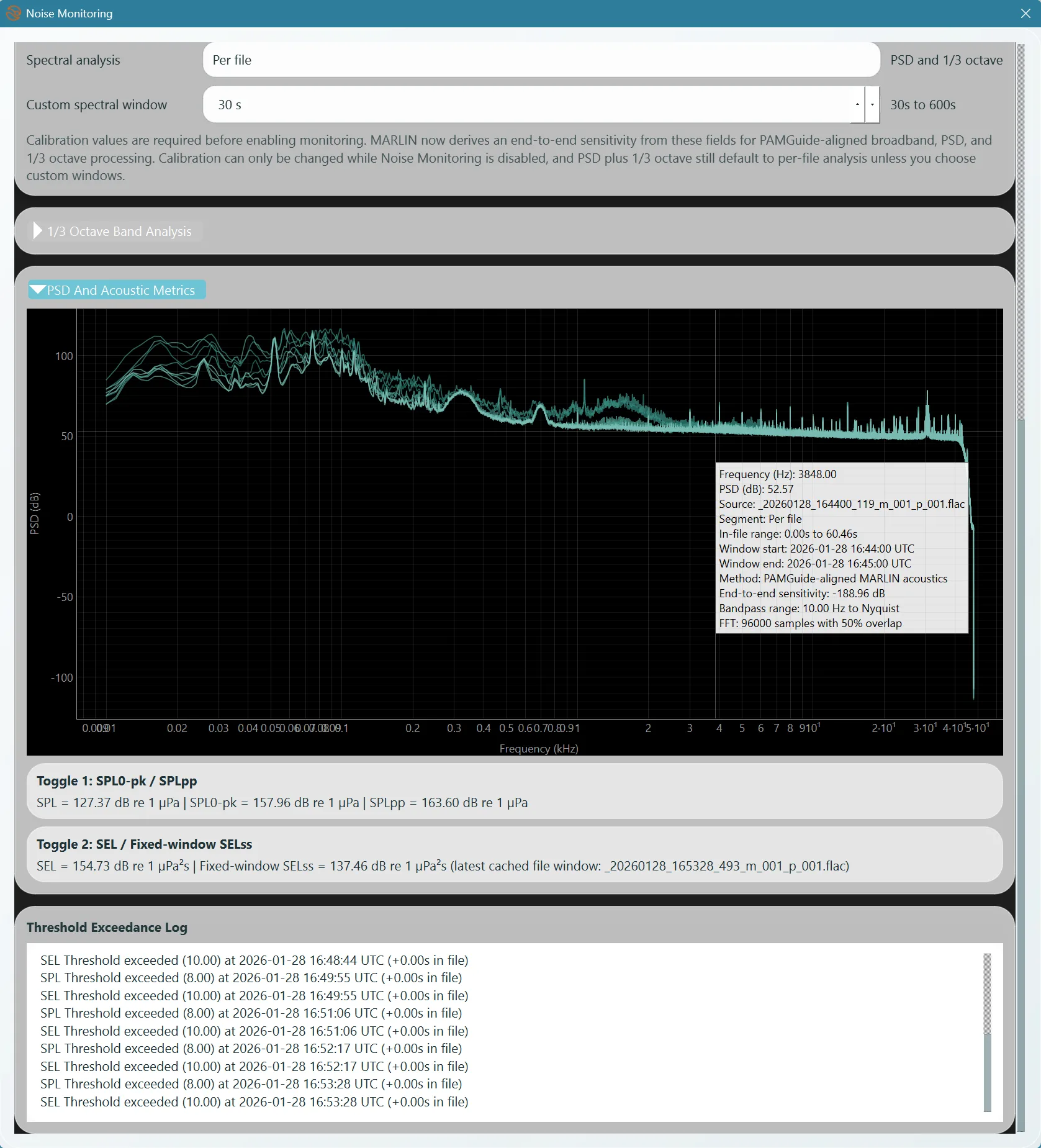
Impulsive noise generated during offshore construction remains a key regulatory concern. Marlin automatically measures and logs the metrics required for environmental assessments including variation of:
- Sound Pressure Level (SPL0-pk, SPLpp))
- Sound Exposure Level (SEL / Fixed-window SELss)
- Power Spectral Density (PSD)
- 1/3rd Octave Band SPL Analysis
The thresholds are customisable, when noise levels exceed the set threshold, operators will be notified via the app or email.
Together, these metrics provide the acoustic evidence required to support environmental reporting and compliance obligations under UK and EU offshore development laws.
How does Marlin simplify underwater acoustic monitoring?
Unlike systems that rely on multiple vendors or disconnected datasets, Marlin is calibrated and connected across the entire monitoring chain, including:
- Hydrophones
- Data Acquisition Hardware
- Processing Software
This secure, end-to-end service provision provides confidence in data quality and traceability throughout a project lifecycle.
Operators can access live and historical monitoring data remotely through the Marlin Connect desktop application, enabling project teams to review acoustic information from anywhere in real time.
The Marlin system consists of three integrated components:
Marlin Link: The self-contained telemetry hardware deployed in the field. It connects to our acoustic recorders, captures data and transmits it securely for processing. Rugged and built for real-life marine environments, its reliable and requires minimal intervention.
Marlin Cloud: The secure processing layer. It receives and stores incoming acoustic data, runs AI-enabled analytics and generates real-time alerts, turning raw sound and data into tangible, structured information.
Marlin Connect: The desktop application where users interact with the system. It provides live and historical data visualisation, detection results, analysis tools and export functionality, turning information into action.
With Marlin Link installed directly onto a buoy or fixed platform, the system operates autonomously without the need for dedicated vessels or onboard crews, helping reduce monitoring costs while maintaining continuous environmental oversight.
How does Marlin support offshore wind environmental compliance?
By bringing harbour porpoise detection, acoustic anomaly monitoring and impulsive noise metrics together within a single platform, Marlin provides offshore developers with a practical and scalable solution for meeting modern environmental monitoring requirements.
Publications
The first peer reviewed article on Marlin and its technical capability is available here.
For more information about Marlin please reach out to the team.