

Innovasea Acoustic Tags
Acoustic transmitters for fish tracking, designed to suit different species, environments and study goals
Innovasea acoustic tags are the world-leading solution for tracking aquatic animals, used across everything from small freshwater studies to large-scale ocean research. With a wide range of sizes, frequencies and sensor options available, they can be tailored to suit almost any study.
The right tag comes down to what you want to measure, the species you’re working with, and the environment you’re working in. Lower frequency tags offer longer range and battery life, while higher frequencies suit smaller species and more complex environments. For behavioural insight, accelerometer tags add another layer, and in high-density studies, options like Increased Residency help you get more from every detection.
Standard Acoustic Tags (69kHz / 180kHz / 307kHz)
Innovasea coded acoustic transmitters come in multiple frequencies and sizes for tracking aquatic animals from smolts to sharks. They are the world‑leading technology for acoustic telemetry fish tracking.
Key Features
- Internationally identifiable unique tag IDs.
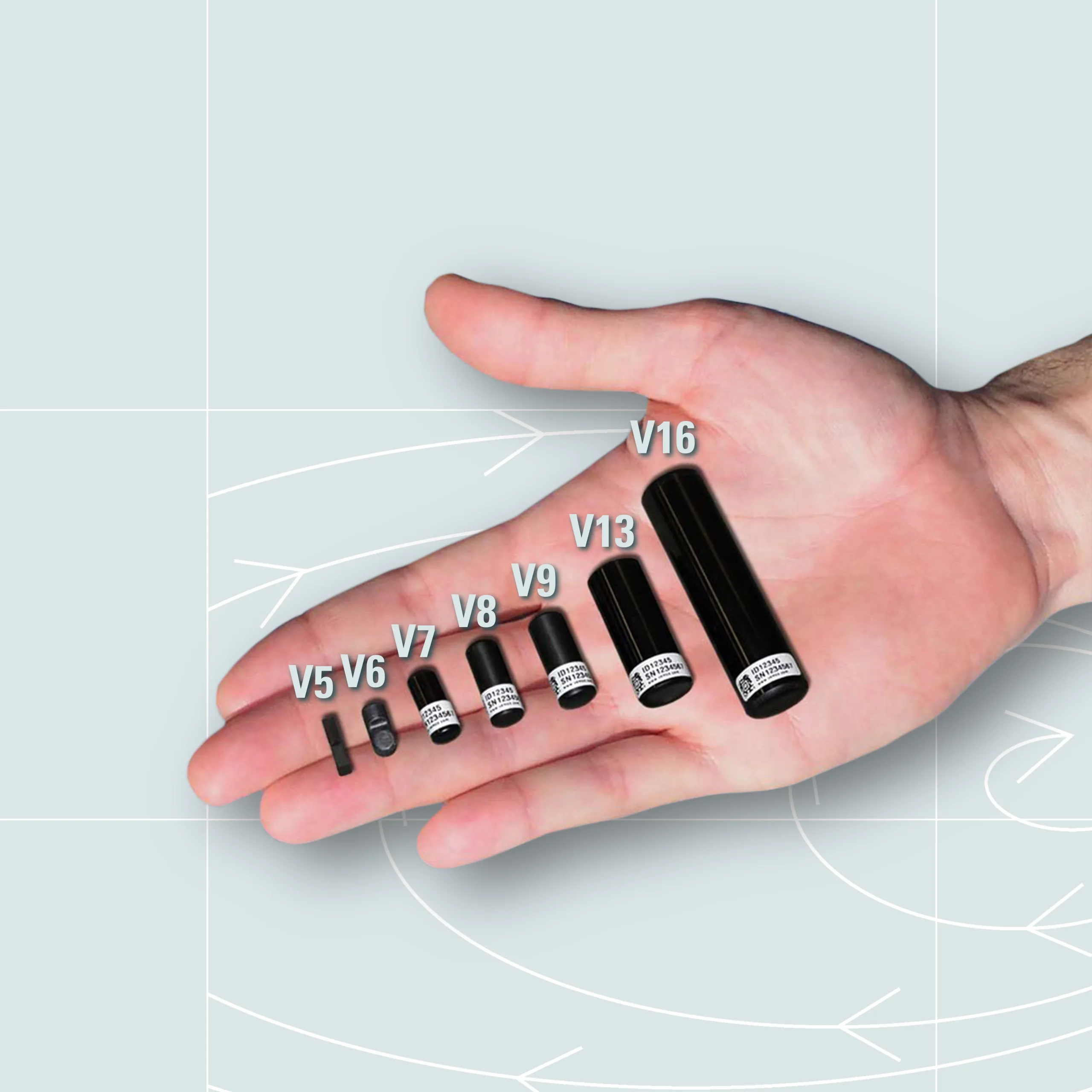
- Sizes from 6.3 mm to 16 mm for species of different body mass.
- Optional temperature and depth sensors.
- Battery options supporting one‑month to multi‑year studies.
- 180 kHz tags offer dual HR/PPM coding, while the 307 kHz V3 tag is ultra‑small for high‑noise environments.
Innovasea acoustic tags emit coded transmissions that are uniquely identifiable by Innovasea receivers. By choosing between 69 kHz, 180 kHz and 307 kHz frequencies, you can optimise detection range, resolution and tag size for your study area. Sensor‑equipped models monitor temperature and depth alongside location, and the smallest 307 kHz tag (V3) weighs just 0.3 g. 180 kHz tags offer High Residency (HR) coding in addition to traditional Pulse Position Modulation (PPM), enabling larger sample sizes without compromising detection. Detection ranges can exceed several hundred metres depending on conditions.
Accelerometer Tags
Accelerometer transmitters measure the activity of tagged animals, revealing behaviour as well as position.
Key Features
- Activity algorithm measures overall body movement; tailbeat algorithm measures fin or tail movement.
- 3‑axis acceleration sampled at 12.5 Hz.
- Optional pressure (V7AP, V9AP, V13AP) and temperature (V16AT) sensors.
- Useful for estimating swim speed, detecting mortality, and studying feeding and spawning behaviours.
- Compatible with NexTrak R1, VR2Tx, VR2AR and VR4‑UWM 69 kHz receivers.
Accelerometer tags transmit activity data alongside location. They operate in two modes: the Activity algorithm summarises overall motion, whereas the Tailbeat algorithm focuses on the undulation of a specific appendage such as the tail. Acceleration is captured in three dimensions at 12.5 Hz to create a detailed picture of behaviour over time. Sensor options include pressure for depth and temperature for thermal context. Use cases range from estimating swim speed to detecting predation events and studying responses to oxygen, salinity or temperature changes. These tags pair seamlessly with Innovasea’s 69 kHz receiver family.
Predation Tags
Predation transmitters detect when a tagged animal has been eaten, separating predation from other mortality.
Key Features
- Polymer capsule dissolves in a predator’s stomach, triggering a transmission change.
- Indicates time since predation to support survival analysis.
- Optional temperature sensor models (V6D, V7D, V9D) record ambient and predation‑event temperatures.
- Supports HR, HTI and PPM coding options across models.
- Compatible with HR3, VR2W‑180 kHz, HR2, VR4‑UWM and NexTrak R1/VR2Tx/VR2AR receivers.
Predation tags allow researchers to distinguish fish eaten by predators from those that die naturally. When the polymer capsule dissolves, the tag changes its ID code or begins a timer to indicate time since predation. This information improves survival models and helps quantify predation pressure. Temperature‑sensor versions transmit ambient temperature until predation occurs and then report the temperature at the time of consumption. Coding options include High Residence (HR), HTI and PPM so that tags integrate with existing Innovasea receivers. Different models operate at 307 kHz (V3D), 180 kHz (V5D) and 69 kHz (V6D/V7D/V9D), and each pairs with the appropriate receiver family.
Continuous Tracking Tags
Continuous transmitters emit a regular ping for real‑time tracking and active surveys.
Key Features
- Factory‑set ping intervals of one to three seconds.
- Available in 9 mm, 13 mm and 16 mm diameters.
- Temperature and depth sensor options for V9, V13 and V16 models.
- Designed for use with the VR100 active tracking receiver and directional or omni‑hydrophones.
- V16 models offered in internal epoxy or external PVC case styles.
Continuous tags send a steady acoustic ping rather than coded bursts. This makes them ideal for vessel‑based tracking and short‑term, high‑resolution movement studies. The ping interval is factory set between one and three seconds, and the tags are available in 9, 13 and 16 mm sizes to suit different fish sizes. Sensor‑equipped models monitor temperature and depth, and the V16 can be supplied as an internal epoxy implant or an externally mounted PVC tag with attachment points. Continuous transmitters are used with Innovasea’s VR100 active tracking system and compatible hydrophones.
Increased Residency Programming
Increased Residency (IR) is a programming option for Innovasea 69 kHz tags that increases detections in crowded arrays.
Key Features
- Up to ten times more detections by reducing code collisions.
- Provides roughly 40 % greater detection range and improved performance in noisy environments when paired with NexTrak receivers.
- Requires NexTrak R1 or NexTrak AR receivers with firmware 7.x.x or later; supported by VR100‑300 deckbox, Rx‑LIVE, Fathom Connect (4.7.x+) and Fathom Mobile (3.2.x+).
- VR2 receivers can detect IR tags but will not deliver increased detection efficiency.
IR programming is designed for high‑density studies where many tags are detected at once. By addressing code collisions, IR allows researchers to reduce transmission delays, increase sample sizes and add more tagged animals without sacrificing data quality. It is exclusively available for Innovasea 69 kHz tags and requires compatible NexTrak receivers running the latest firmware. While VR2 receivers will decode IR tags, only NexTrak receivers provide the full efficiency benefits. IR is particularly useful for spawning grounds, migration bottlenecks and other high‑residency environments.
HTI coded transmitters (307 kHz)
HTI‑coded 307 kHz tags deliver high‑resolution positioning for challenging freshwater environments.
Key Features
- Fine‑scale 2D/3D positioning with sub‑metre resolution and detection ranges up to one kilometre.
- Immune to signal collisions and capable of over 500 000 unique codes.
- Multiple sizes and battery options provide tag life of up to five years.
- Optional PIT tag inclusion for detection when the fish is out of water or after the acoustic battery expires.
- Pair with Model 290/291 receivers, 395 data logger, 590 hydrophone and HR3 High Residence receiver.
Operating at a higher frequency, HTI‑coded tags are designed for noisy or reflective freshwater habitats such as hydropower facilities. They provide sub‑metre positioning at ranges up to one kilometre and use an encoded signal that prevents tag collisions while allowing many individual fish to be tracked simultaneously. Tag life can extend to five years depending on pulse rate and model, and optional PIT tag integration allows continued detection on land or in passive systems. These tags are compatible with HTI’s 290‑series receivers, the 395 data logger, 590 hydrophones and the HR3 High Residence receiver.